What a year! I wrapped up my position in Chicago and moved back east to begin a new position in New York City which starts in August 2026. For now, I’m a bit nomadic, working in Arizona during winter, and then traveling and grounding myself over the summer before the new job.
This calendar features photos of bees (roughly according to the season they can be found in) and some of their favorite flowering plants. This year’s calendar aims to give more equal weight to the plants and the bees, reflecting my increasingly frequent forays to botanize alongside watching bees. Below you’ll find information on each feature species accompanied by my musings on the scene.
January 2026
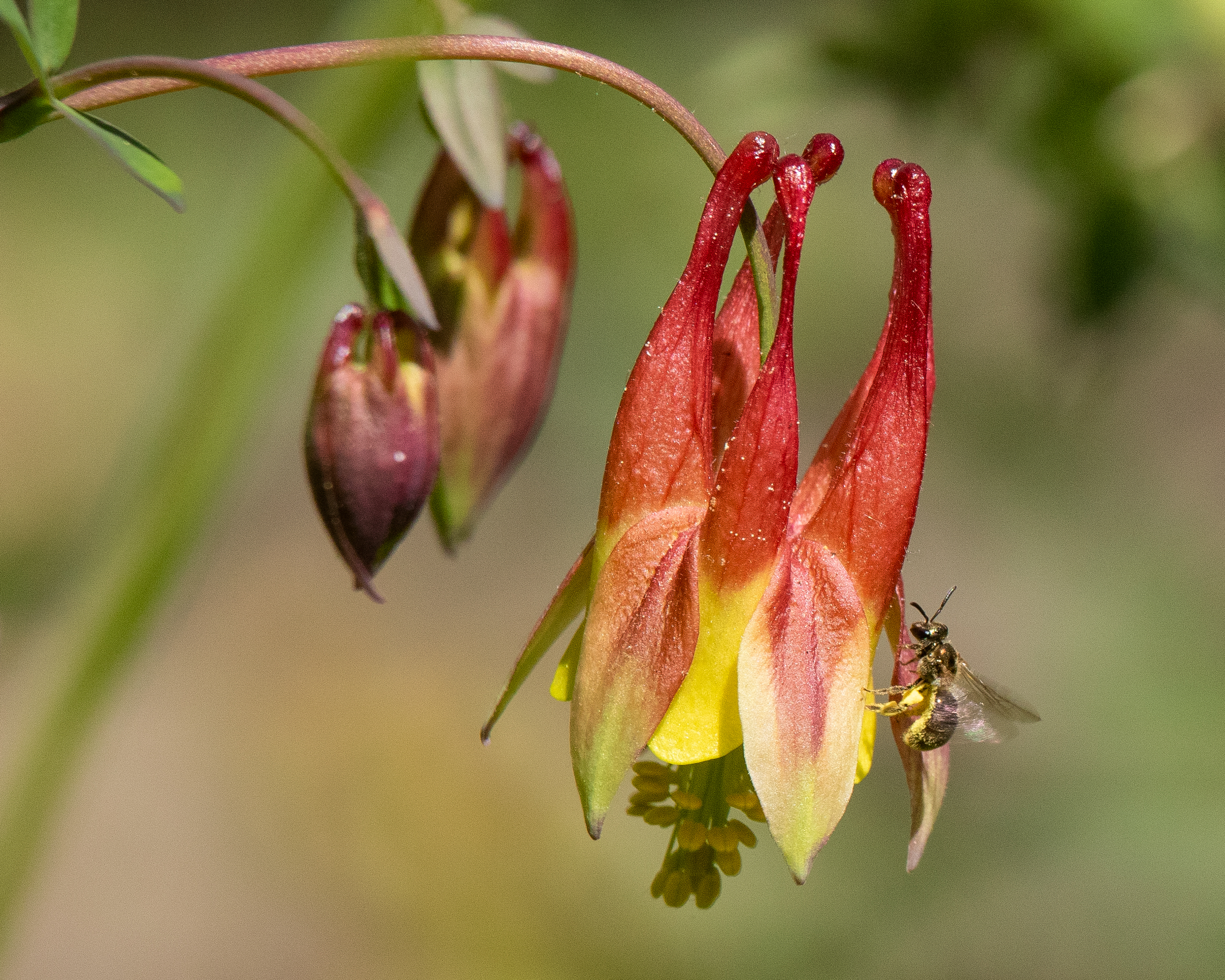
Sweat bee (Lasioglossum sp.) on red columbine (Aquilegia canadensis)
Each morning this past May, sun in my face, coffee in hand, those little red lanterns lit up my heart with delight. Another delight? This little sweat bee having to climb all the way up the long nectar spur to get what it was after. (The thing about delights is that once you start looking for them, you find that they are everywhere.) Hummingbirds don’t have this problem —they pull up, get their face covered in pollen, and sip the relatively large volumes of nectar.

February 2026
Currant mason bee (Osmia ribifloris) on pointleaf manzanita (Arctostaphylos pungens)
This winter from January through March I’ll be studying this dazzling mason bee in The Santa Catalina Mountains outside of Tucson, Arizona. Males and females emerge in the mid-elevation grasslands where they complete their life cycles with manzanita (Arctostaphylos spp.) pollen. To study them, we’ve constructed several neighborhoods of “bee condos” by drilling wooden boxes with cavities exactly to their liking and hanging them from dead trees to mimic their natural nesting habitat.

March 2026
Horn-faced mason bee (Osmia cornifrons) at nest
This bee and I were roommates for a few weeks in March 2025. During that time she found a crack in the foundation of our home, plastered the inside with mud (how considerate!), and filled the mud-walled chambers with pollen from redbud trees. And so we slept head-to-head, my head to the wall from inside and her head to the wall from outside. Many cavity-nesting bees are often said to occupy dried stems or old beetle holes in dead trees, but it’s worth noting that for Osmia cornifrons cracks in the cement will do just fine. Males and females don’t even seem to be interested in trees in urban Chicago–they patrol up and down buildings looking for mating and nesting opportunities.

April 2026
Golden northern bumble bee (Bombus fervidus) on wood-betony (Pedicularis canadensis)
I’m lying belly down in the middle of Somme Prairie. The Metra train north to Fox Lake roars by. Old burned stems of prairie dropseed skewer my legs through my pants. A few feet in front of me is the jewel of the prairie: a field of butter-yellow wood betony (Pedicularis canadensis). Staring down at the spiraled flowers you can see the entire Milky Way turning on its axis. Then a big buttery Bombus fervidus comes barreling in for a sip of nectar. Ah, the world.

May 2026
Megachile mucida on false indigo (Baptisia cultivar)
A bumble bee that’s not a bumble bee. Megachile mucida does a good job hiding in plain sight by mimicking bumble bees. And she’s so good at it–so obscure, even to scientists–that she has no common name. A few years back I had the opportunity to study a site where dozens of females were nesting. Throughout the day females would dig shallow tunnels underground and fill the terminus of each tunnel with leaf discs cut from nearby ironwood trees (Carpinus caroliniensis). Then, she’d fly out into the garden of false indigo (Baptisia spp.) where she’d pry open the flowers and scrape pollen on to the long hairs beneath her abdomen.

June 2026
Protandrena albitarsis on purple coneflower (Echinacea purpurea)
Many bees, including Protandrena albitarsis, could be mistaken for gnats. The way they hover around flowers in small dark clouds doesn’t exactly invite comparison to better known bumble bees. I ran into this rice-sized bee all over Chicago wherever summer blooming asters were planted. On this small planting of purple coneflower (Echinacea purpurea), Protandrena albitarsis was throwing quite the party. Females mating with males, males attempting to mate with other males, males throwing other males off of females, threesomes, and in this photo what may be a foursome? Two males approaching a female with a male on her back.

July 2026
Wilke’s mining bee (Andrena wilkella) on white clover (Trifolium repens)
The best place to find a bee that loves clover is, well, on a clover. Wilke’s mining bee (Andrena wilkella) is common in disturbed sites and lawns in the summer wherever exotic and fabulous Fabaceae plants (white clover, red clover, bird vetch, and bird’s foot trefoil) grow. In this case, I was belly down on a lawn in Maine absolutely beside myself.

August 2026
Beebalm shortface (Dufourea monardae) on wild bergamot (Monarda fistulosa)
Is there a pollinator garden out there that doesn’t contain wild bergamot?? Truly, a rewarding and forgiving plant. Does well in containers, easy to grow from seed, and attracts the most dazzling array of bumble bees, swallowtails, and hawkmoths and, yes, bee balm bees (Dufourea monardae), a bee whose entire life cycle revolves around this plant. They aren’t exactly the most conspicuous of flower visitors, but it certainly helps to know to look for them. Oh, and the other bee balms–Oswego tea (Monarda didyma) and spotted horsemint (Monarda punctuata)–are simply unacceptable for this bee; they are not used as host plants.

September 2026
Sunflower mining bee (Andrena helianthi) on sawtooth sunflower (Helianthus grosseserratus)
Sunflowers have nasty (but, for some bees, medicinal) pollen that has led to a high degree of specialization. Depending on where you look there are usually a handful of sunflower and aster specialists floating around. In this case, I ran into the sunflower mining bee (Andrena helianthi) which, interestingly, is not the only mining bee that is a sunflower specialist. They are big, about the size of a honey bee and often found with their legs packed with sunflower pollen. To complicate matters, not all sunflowers are created equal in the eyes antennae of this bee. This species is more fond of the perennial sunflowers with many small heads than the big-headed annual ones often cultivated in urban gardens.

October 2026
Cloudy-winged mining bee (Andrena nubecula) on white wood-aster (Eurybia divaricata)
If, in late August, you were to wend along the banks of the Miller’s River in western Massachusetts, a cold, oxygenated river that sings with delight, you would invariably find the earth dusted with the white and blue powder of wood-asters, plants that place you very firmly during late summer in deciduous temperate forests. And if you, because you had no immediate plans calling you elsewhere, were to linger in this sudden and holy space, you may turn your attention to how the light is filtered by the canopy above creating pockets of light and dark. And if, like me, you turned your attention to those well lit spaces, you may find to your delight a small dark brown bee walk-flying from flower to flower. Having done all those things you too would have encountered the cloudy-winged mining bee (Andrena nubecula), a bee which depends entirely on late-season aster pollen to complete its life cycle. And when she leaves and heads off for home, to where does she go? Only she knows that.

November 2026
Slender-faced masked bee (Hylaeus leptocephalus) on swamp milkweed (Asclepias incarnata)
Can you find him? The tiny black-and-white bee hanging on to swamp milkweed with a third of his legs? Here, one July afternoon in my back garden in Chicago, a whole school of slender-faced masked bees swirled around the flowers. Although the baseline condition of all masked bees is total chaos–their flight patterns look more like the physical manifestation of static electricity than of grace–I was able to find a moment of calm as this bee stopped to thoroughly clean his antennae and proboscis.

December 2026
American bumble bee (Bombus pensylvanicus) on purple coneflower (Echinacea purpurea)
Lurie Garden–despite being a naturalistic, part-native urban garden–is an unlikely place for nature. It’s situated on top of a parking garage in the middle of downtown Chicago, surrounded by buildings, cement, and lawn. And yet! During a series of outreach workshops my students and I led this summer, we encountered dozens of species of bees, butterflies, wasps, and beetles on the flowering plants. Our most notable sighting was American bumble bee (Bombus pensylvanicus), a species which has disappeared from much of its historic range in recent years. The conservation value of urban gardens planted with intention and native plants continues to astound me.
