Nick’s bee calendar is back, and this time features bees and bee stories from my first full year in Chicago. Below you’ll find information on each feature species accompanied by various natural history or field notes from the sighting.
This calendar features photos exclusively of bees that can be spotted in Chicago. Many of these bees are found in backyards and cities throughout eastern North America, too. Check out the species profile pages for tips on how to identify them and which flowers to plant to attract them.
Skunk Cabbage Books in Chicago’s Avondale neighborhood will be featuring my calendars in their holiday selection. I highly recommend stopping in to check out their selection and chatting with the owner Ren who is an avid naturalist and birdwatcher (and beewatcher).
January 2025
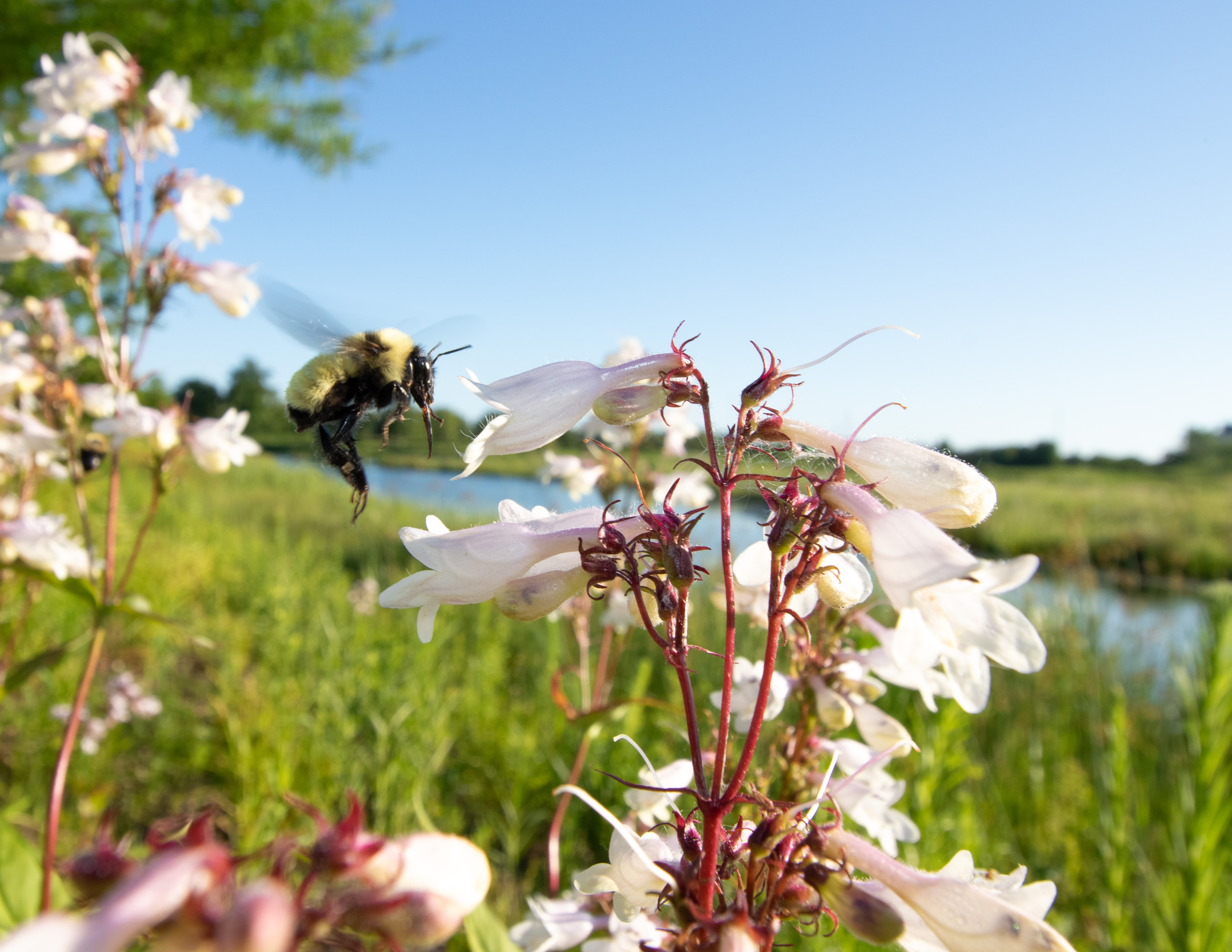
Golden northern bumble bee (Bombus fervidus) on foxglove beardtongue (Penstemon digitalis)
I’ve noticed that some bees approach flowers with their tongues out. Are they getting a head start? Tasting the air as they go? Perhaps assessing whether or not the flower will be a profitable stop in terms of nectar? Among bumble bees, golden northern bumble bees (Bombus fervidus) have particularly long tongues which enable them to access nectar from deep flowers like foxglove beardtongue (Penstemon digitalis). Bombus fervidus is one of about ten species of bumble bees that can be regularly encountered in Chicagoland and is the only one with bright yellow hairs most of the way down its abdomen.

February 2025
Pure gold sweat bee (Augochlora pura) in hibernacula
Last February, on a bright, bracing blue day, I ventured out to Harms Woods along the north branch of the Chicago River. Besides craving the sounds of chickadees and red-bellied woodpeckers, I was hoping to find an overwintering site of pure gold sweat bees (Augochlora pura). Females spend the winter hunkered down inside rotting logs—the same places where those females will build nests the following year. After a bit of searching, I struck gold emerald. I found the “hibernacula” of a dozen of Augochlora pura females, each tucked into small hollowed out chambers each about the size of a jelly bean. The inside was lined with the fleece of soft rotten wood. By April, the first Augochlora pura will emerge. They’ll complete two, maybe three, generations before fall depending on how long the growing season lasts. This solitary bee occurs in backyards and gardens, even in the middle of a city, provided that there’s some old logs nearby for nesting.

March 2025
Carlin’s mining bee (Andrena carlini) on trout lily (Erythronium americanum)
In my kitchen I have a print that reads “Make Time for Trout Lilies.” It is a reminder that the season of spring ephemerals—those forest floor wildflowers that complete their life cycles in the brief, bright period before the canopy leafs out—and the natural world in general cannot wait until tomorrow. In many of the forest preserves of Cook County, especially where prescribed fire has been returned to the woods, trout lilies abound. And the bees cannot get enough. Carlin’s mining bee is a common forest bee that visits a variety of spring flowers including native species like trout lilies and exotic species like garlic mustard. Although they look a lot like bumble bees, these bees carry pollen dry on their legs (instead of in a moistened pellet) and they are much smaller than the queen bumble bees that are active at this time of year.

April 2025
Eastern carpenter bee (Xylocopa virginica) on eastern redbud (Cercis canadensis)
Witnessing the total solar eclipse in Ninevah, Indiana is up there as one of the most memorable events of my life. (See you in Spain 2026?) The day after the eclipse, my friends and I went hiking in the nearby woods where I had the chance to meet spring bees weeks before they would be out in Chicago. The song of Louisiana waterthrush echoed off the low ravines. A red admiral folded its wings and became a leaf. The understory glowed with cutleaf toothwort, celandine poppies, and violets, but one of the best places to watch bees was actually on a handful of eastern redbuds (Cercis canadensis) in the parking lot. Long gangly stems like pink pipe cleaners draw in a menagerie of insects: queen bumble bees, cellophane bees, carpenter bees, mining bees, mason bees, hover flies, duskywings, spring azures, and a look up into the sky revealed dozens of other insects blurring around the canopy. Often mistaken for bumble bees, eastern carpenter bees (Xylocopa virginica) have dirty golden hairs on their thorax and males like this one have greenish eyes and a cream-colored square on their faces which bumble bees never do. His big “bug” eyes are also a giveaway, useful for tracking potential mates and for keeping his territory free of other males.

May 2025
Masked bee (Hylaeus spp.) on flowering blackberry (Rubus spp.)
Bees are flower powered. All their nutrition comes from pollen which is protein and nectar which is a sweet and salty liquid sort of like Gatorade. A close inspection of this photograph reveals a masked bee (Hylaeus) playing with its food: it has pinned a bubble of nectar between its mandibles and is massaging the bubble with its mouthparts. This is an example of “nectar bubbling.” Bees often prefer a sweeter nectar than produced by flowers, and for a similar reason to why hikers opt for freeze-dried lentil meals, it is more energy efficient for a bee to carry a concentrated calories. In this way, bubbling is thought to help concentrate the nectar before flight, which may be especially important for tiny bees that carry all of their provisions internally.

June 2025
Ligated furrow bee (Halictus ligatus) on groundsel (Packera)
Ligated furrow bees are never found far from an aster, whether it’s a weedy exotic aster like chicory or bull thistle, or a native aster like this groundsel. I love the movement in this photograph, how the bee is leaping from one flower to the next as it gathers pollen. Moments like these are easiest to see when you get down at eye level with a bee and, indeed, I was in a deep squat while watching this bee. I constantly have to remind myself to change perspective when I’m out watching bees. What new things do I notice when I watch bees from below as opposed from above?

July 2025
Rusty-patched bumble bee (Bombus affinis) on wild bergamot (Monarda fistulosa)
For years I had read about (and taught about) the plight of the rusty-patched bumble bee (Bombus affinis), how it used to be quite common from Massachusetts to Minnesota but now resides in just a few remaining patches in the upper midwest and West Virginia. This bee was the first species in the continental United States to be listed as federally endangered. So, imagine my delight (and surprise!) when my student Jenny and I stumbled upon a rusty-patched bumble bee worker during our field research at Chicago Botanic Garden this summer. In the weeks following our sighting we found nearly 10 other individual rusty-patched bumble bees, and this species became the fourth most common bumble bee species on our surveys. One of our most exciting results from this summer? That human-designed spaces like gardens can truly be sites for conserving nature.

August 2025
Pugnacious leaf cutter bee (Megachile pugnata) on annual cosmos (Cosmos bipinnatus)
This past year, I installed a small bee hotel in my backyard. If you’re not familiar, a bee hotel is a structure that provides homes for cavity-nesting solitary bees. My particular hotel is hinged on the spine and lined with plexiglass so I can take a peek at what’s happening within the nest of a solitary bee. As it turned out, my observation box ended up being occupied by several different species, including a mason bee, a bellflower resin bee, and a pugnacious leaf cutter bee. The leaf-cutter bee only hung around for a few days during which she laid two eggs, but she nonetheless delighted me for that time. Upon leaving her nest, I noticed she would forage only 10-15 feet away on the annual sunflowers that I had planted in my backyard. Knowing that I can provide everything that needs to complete her lifecycle from flowers to nesting sites in my backyard is extremely gratifying.

September 2025
For this month, my commentary comes from my field notes written shortly after my encounter with these male longhorn bees (Melissodes denticulatus):
“I bring my attention back to what’s in front of me: a slumber party of bees. Longhorn bees, Melissodes denticulatus to be precise, and there are eight or nine of them all crowded on top of each other beneath three flower heads of sweet black-eyed susans (Rudbeckia subtomentosa). They are each about the size of a black bean with long curled antennae, which signals that these bees are boys. And like all bee boys, they do not have a nest to go back to at night (the nest is reserved for bee girls) and so they are left on their own each night to find their hammock out in the garden which tonight happens to be some black-eyed susan flower heads.
They really are all on top of each other. One of them is pinching the edge of a petal with his mandibles, another one is clutching the stem, and at least another two are tucked into the corner between the ray petals and the brown mound of disc petals. That corner looks particularly cozy. I wish I could sleep on a flower head. You know how in The Little Prince he stands on his planet and grows that one flower? Like that.
I lean in for a closer look at another male hanging from the side of a stem. His antennae are nearly the length of his body, and they are two-toned, black on top, and reddish on the bottom, mineral red, like a red stone you might find at the beach. Antennae are his way of perceiving the world. Embedded inside are hundreds of chemical receptors that ensnare fragrances of faraway flowers and the body odors of other bees. In this particular genus of bees, males tend to have extravagantly long antennae that curl at the tips. It is not immediately clear what is gained from having extra-long antennae. Perhaps these exaggerated features improve their chances at finding mates, or perhaps mates are attracted to males with antennae of a particular length. “

October 2025
One of the roundest bees there is. Drury’s longhorn bee (Melissodes druriellus) is like a little caffeinated hedgehog, dashing from flower to flower. These bees are never far from a wood-aster (Symphyotrichum) which is their main source of pollen. Lucky for them, Chicago is not want for wood-asters which can be found in most every vacant lot, restored prairie, or woodland edge in the fall.

November 2025
It’s not Halloween or Thanksgiving without pumpkins, and there are no pumpkins without squash bees (Peponapis pruinosa). This bee’s entire life cycle revolves around pumpkins—no pumpkins, no Peponapis. Talk about a picky eater. But, they are abundant enough in the landscape that if you plant a pumpkin in your yard, then these bees will show up. They will be most easily seen early in the morning when squash flowers are open and laden with nectar. Also, something I learned this year: did you know that Illinois, of all states, is the biggest producer of pumpkins? Somewhere among the factory aisles of industrial corn and soy are vast fields of pumpkins. I wonder if Peponapis can make a living out there, or if commercial honey bees have to be brought in to make up the pollination deficits.

December 2025
Black and gold bumble bee (Bombus auricomus) on false indigo (Baptisia ‘Blue Towers’)
One of my projects at Chicago Botanic Garden is evaluating whether cultivars of common garden plants can attract pollinators. A cultivar is short for “cultivated variety,” basically a wild plant that has been bred to be more attractive to people. When humans meddle with what flowers look and smell like, does that impact how those plants interact with bees and other insects? To answer this question I watch nearly 20 cultivars of false indigo (Baptisia), counting bumble bees and leaf cutter bees as they forage and measuring flower color, shape, and size to understand whether how traits influence attractiveness. Unlike more delicate insects like hover flies and butterflies, bumble bees are particularly adept at prying apart the Baptisia flowers to access the nectar deep inside.
