Every year, I make a holiday calendar for my family and friends of my nature photography. For the past few years, as my obsession with bees has deepened, my calendars have naturally featured photos of wild bees almost exclusively (surprise, surprise). One consistent piece of feedback that I have received from recipients is that they would like to know more about the bees featured for each month. So, for this year’s calendar, I have compiled field notes about each featured bee and the context in which I found them.
January 2024

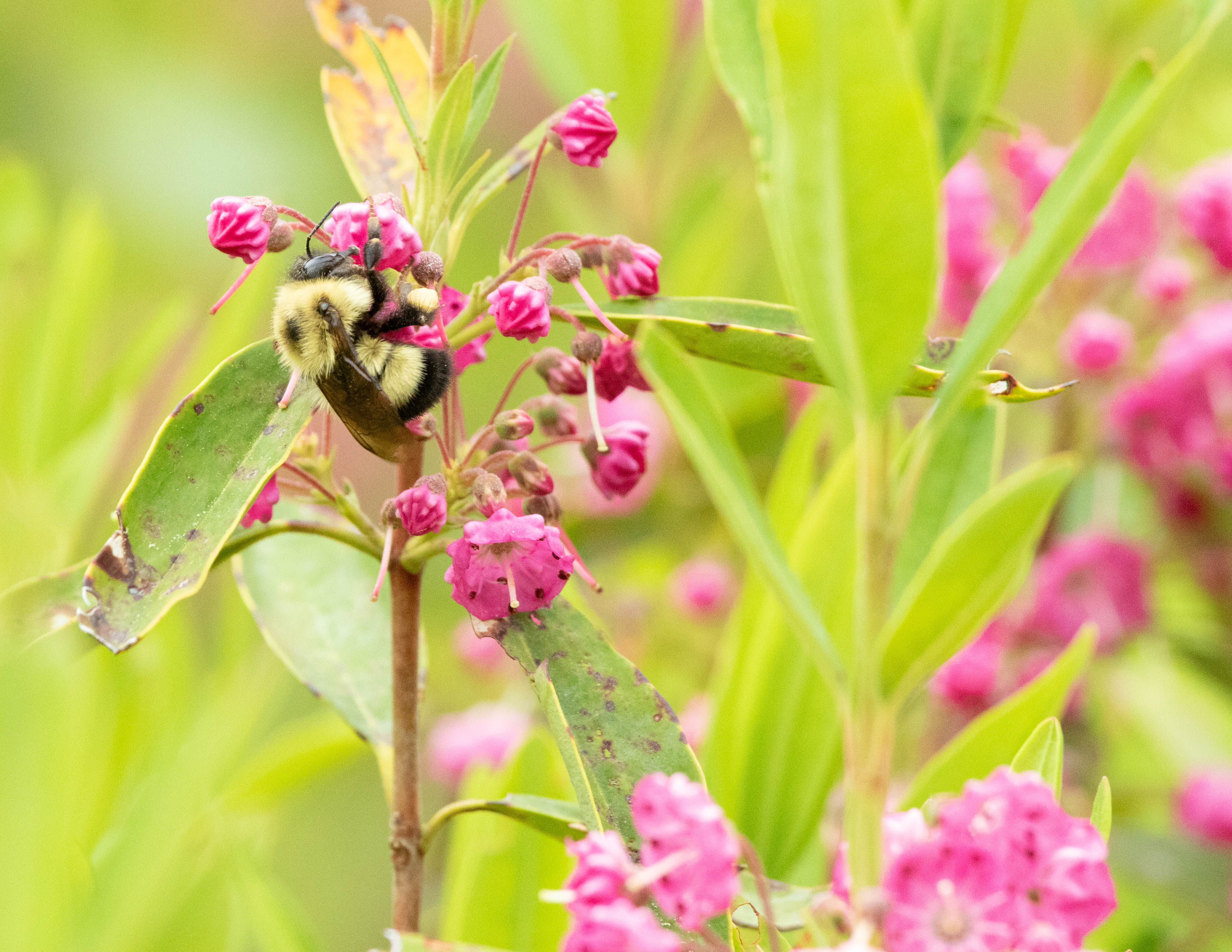
- Bee: half-black/Sanderson’s bumble bee (Bombus vagans/sandersoni)
- Flower: sheep laurel (Kalmia angustifolia)
- Place: Eagle Hill Institute, Steuben, ME
Kneeling in the middle of the sheep laurel shrub, I noticed tiny plumes of white pollen: buzz pollination in action. This worker bumble bee (Bombus vagans/sandersoni) was shaking her body so vigorously that pollen was bursting from the flowers. Half-black bumble bees (Bombus vagans) look quite similar to Sanderson’s bumble bee (Bombus sandersoni), and together, this pair is common in forested landscapes throughout New England from May through September. I took this photo at Eagle Hill Institute in Steuben, Maine—a field school for adult nature lovers—during the week that Max and I co-taught our “Natural History of Wild Bees” course. We will be teaching our course again from June 23-29, 2024.
February 2024

- Bee: unequal cellophane bee (Colletes inaequalis)
- Flower: none
- Place: Arlington Great Meadows, Lexington, MA
By the time February rolls around, bee season is imminent in the northeast. Unequal cellophane bees are one of the earliest bees to emerge–a promise of spring–often commencing activity while there is still snow on the ground. Here, a female rests in the entrance to her nest. Females dig nests in close proximity to one another, resulting in nesting aggregations ranging from tens to thousands of nests. To help distinguish her nest from others, females situate nests next to conspicuous objects, such as a pile of leaves, or discarded things like bottle caps and candy wrappers, and also use distinctive scent markings that she can smell when she gets close. On warm days, she’ll fly up into the trees to gather pollen from red maples and willows.
March 2024

- Bee: mining bee (Andrena sp.)
- Flower: trout lily (Erythronium americanum)
- Place: Middlesex Fells Reservation, Medford, MA
Nothing says spring quite like the arrival of spring ephemerals, those forest wildflowers that complete their annual duties in the short window of time when temperatures are warm enough for growth but the trees have not yet leafed out. Trout lily–named for the speckled patterning on the leaves like a trout tugged fresh from a river–is one of those spring ephemerals. One morning in Middlesex Fells, the stream surged with meltwater, grackles screeched high in the red maples, and trout lily flowers carpeted the bright, cold forest floor. Visiting the flowers were large bumble bee queens (Bombus bimaculatus), smaller bumble bee lookalikes including Carlin’s mining bee (Andrena carlini) and bufflehead mason bees (Osmia bucephala), and smaller grayish mining bees (Andrena sp.) like the one in this photograph. They drank nectar from those yellow carousel tents, and scraped the rusty pollen off the anthers into long hairs on their legs. You can see a dusting of pollen along tips of the petals (bees being messy). The dark spots close to the inside of the flower are known as “nectar guides”—markings on flowers that signal to a pollinator where the nectar is, sort of like how lights on a runway signal to a pilot where to land a plane.
April 2024

- Bee: Golden green sweat bee (Augochlorella aurata)
- Flower: blackberry (Rubus sp.)
- Place: Knoll Farm, Fayston, VT
Kermit the Frog sang about how it’s not easy being green, but Augochlorella seems to do just fine. Perhaps being green gives this forest-associated bee a camouflage advantage in the green filtered light of the understory. These tiny emeralds–known as golden green sweat bees–are a social species. A queen starts a colony underground in spring, and a couple dozen worker females help to grow the colony throughout the summer months. Males are only produced in the fall months to make with new queens for next year. Consequently, this species is one of the most common bees in forests in New England between May and September. I took this photo during a visit with my friend Leslie to Knoll Farm, an Icelandic sheep pasture, spiritual retreat center, and U-pick blueberry farm that sits high about the Mad River in northern Vermont.
May 2024

- Bee: Azalea mining bee (Andrena cornelli)
- Flower: azalea (Rhododenron sp.)
- Place: Garden in the Woods, Framingham, MA
Andrena cornelli feeds entirely on azalea pollen. Ornamental azaleas are common in many landscapes, but the azalea mining bee is not, probably because it is picky about which azaleas it likes. Although its nesting requirements are not fully known, adding native azaleas to your landscape like swamp azalea (Rhododendron viscosum) or pinxterbloom azalea (Rhododendron periclymenoides) is likely one way to attract this bee to your yard. I found several females of this bee teetering like trapeze artists along the tightrope anthers of this native azalea.
June 2024

- Bee: Bicolored striped-sweat bee (Agapostemon virescens)
- Flower: bull thistle (Cirsium vulgare)
- Place: Tufts Park, Medford, MA
Bees love weeds. Many of our native bees are attracted to pink thistle plumes of bull thistle–one of our most pernicious weeds–including the bicolored striped-sweat bee. Females of this species can be identified with the naked eye. They are the only bee in eastern north America with a green thorax and a black-and-white abdomen. See how she holds her wings out, a sign that she has just landed. In a few seconds, as she settles into feeding around the ring of open florets, she’ll fold her wings back and become increasingly approachable. From this photo, I can tell that she is drinking thistle nectar, but not gathering pollen: thistle pollen is snow white, unlike the orange pollen packed into the hairs on her hind legs.
July 2024

- Bee: Sunflower mining bee (Melissodes trinodis/agilis)
- Flower: sunflower (Helianthus annuus)
- Place: New York Botanical Garden, Bronx, NY
Male longhorn bees are hard to get a good look at: they’re always on the move, patrolling up and down patches of flowers in search of females. Patient observers will be rewarded, since male longhorn bees need to replenish their energy from time to time with nectar. Here, a male sunflower longhorn bee takes a good long sip from a sunflower floret. At night, males gather on the sunflower blooms for a slumber party, huddling together along the crease where the petals meet the center disc. If you are curious enough, and have the space and time, I encourage you next year to plant a few sunflower seeds in a pot on your front porch or balcony to watch all of this happen for yourself. This is one of those times where “if you plant it, they will come” certainly applies, especially if you live in an urban or suburban area.
August 2024

- Bee: Common eastern bumble bee (Bombus impatiens)
- Flower: Partridge pea (Chamaecrista fasciculata)
- Place: Tufts Park, Medford, MA
Early August, 6:30am. I wandered down to the community garden before my teaching obligations at Tufts. From a good distance away, I heard a hum that sounded a bit like wind or rushing water, but was, in fact, throngs of bumble bees buzzing on the partridge pea. Flowers on this plant are nectarless and require buzz pollination. Even though about 50% of native bees are capable of buzz pollinating, visitors to partridge pea were are almost exclusively a single species: the common eastern bumble bee. Bumble bees bite the anthers of partridge pea during pollination, and upon closer inspection, you can see little bruises left by the bees on the flowers they’ve visited.
September 2024

- Bee: cloudy-winged mining bee (Andrena nubecula)
- Flower: white wood aster (Eurybia divaricata)
- Place: Millers River, Millers Falls, MA
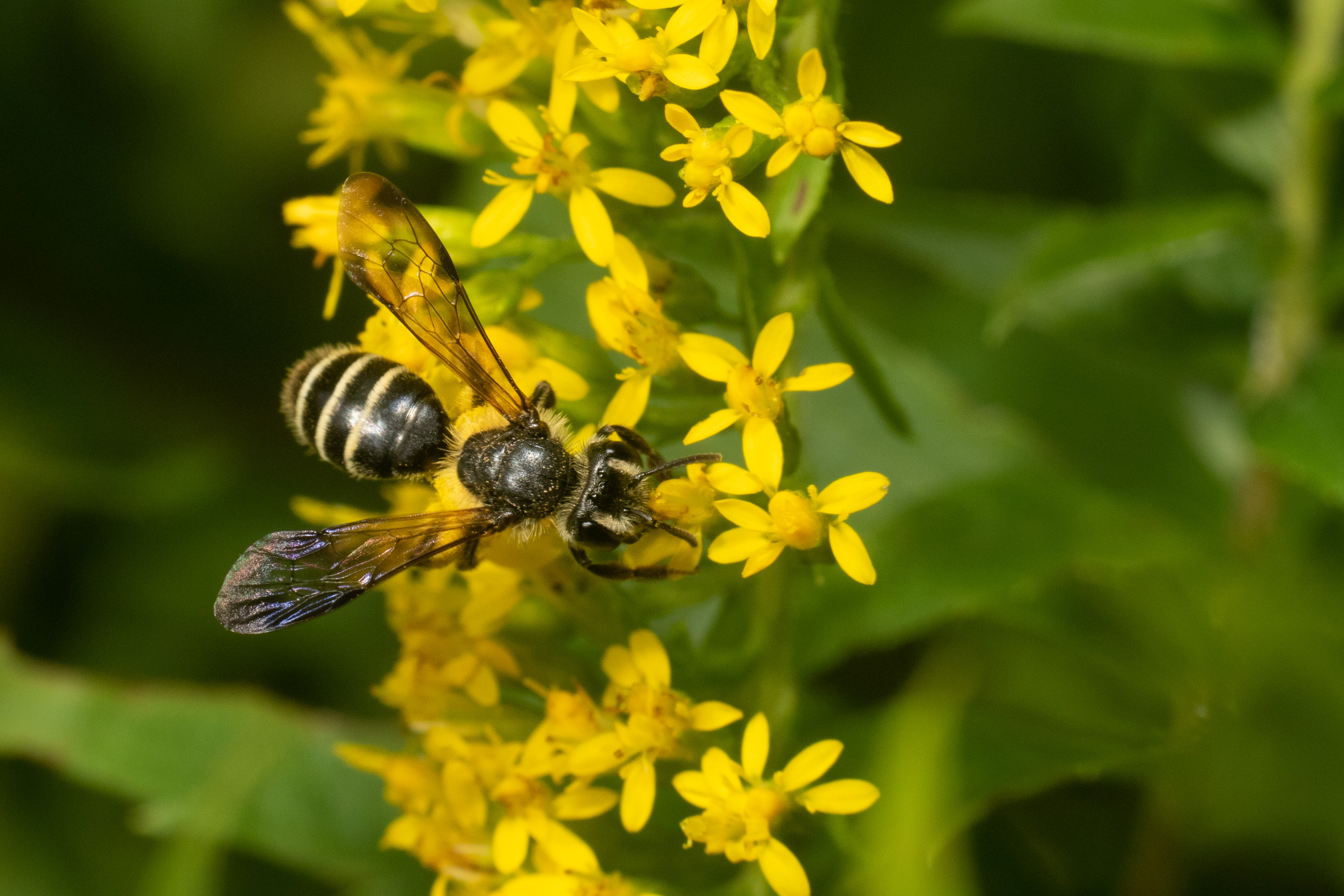
Cloudy-winged mining bees (Andrena nubecula) come out in late-August and they can be found on goldenrods and asters. Little else is known about this bee, but it seems to be closely associated with forested areas where it likely builds its nests. Many asters, including white wood aster, have flowers that change color throughout their lives. The disc florets start out as a rich egg-yolk yellow and change to a purple-red color with age. One hypothesis is that the flowers change color in response to being pollinated. Thus, flower color could serve as an advertisement to pollinators about which flowers should be visited and which ones should not be visited.
October 2024

- Bee: golden northern bumble bee (Bombus fervidus)
- Flower: field thistle (Cirsium discolor)
- Place: Chicago Botanic Gardens, Glencoe, IL
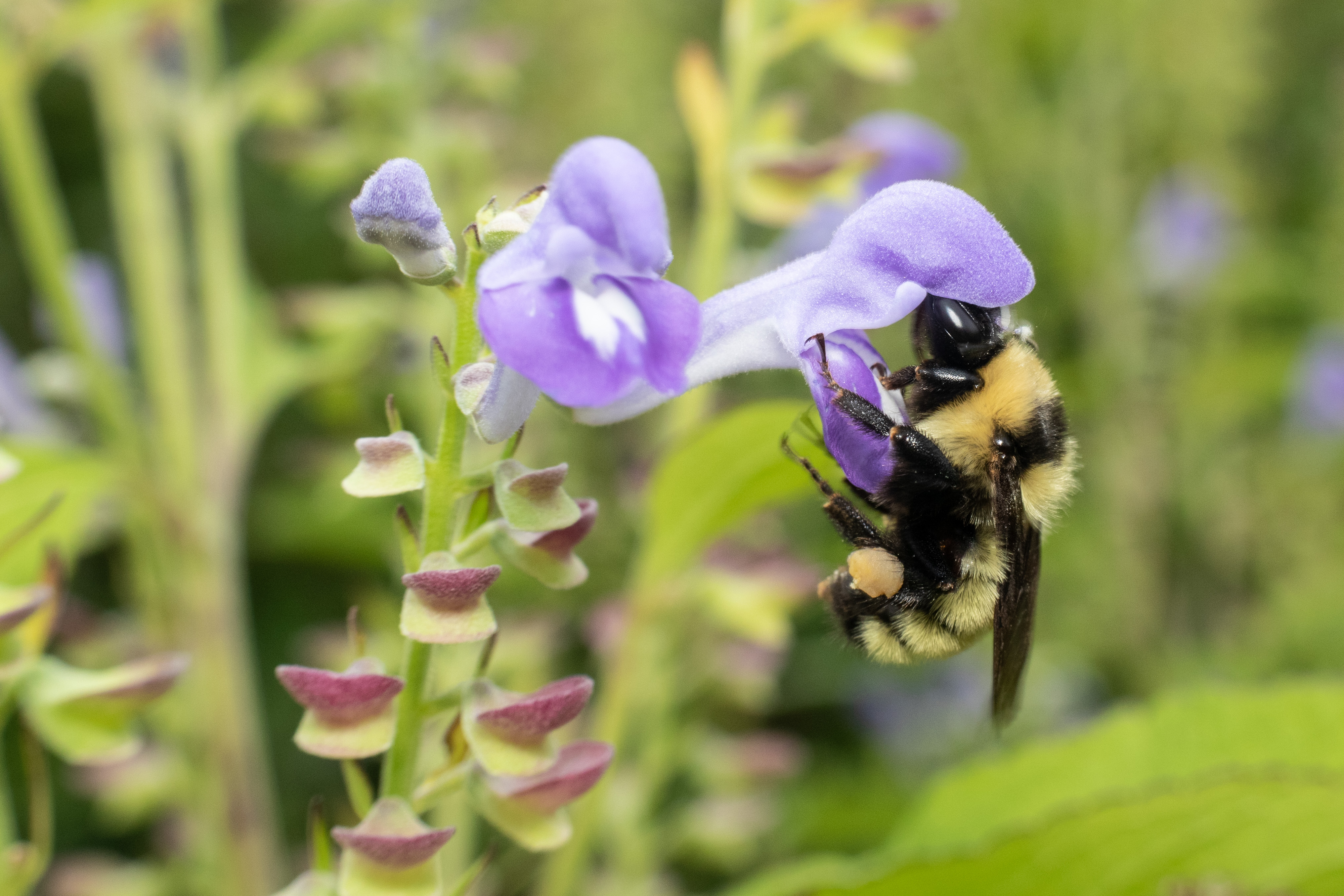
During my first month in Chicago, I made a habit of taking my lunches outside to the Dixon Prairie at Chicago Botanic Garden. PLW, prairie lunch walks. This 30-year prairie garden demonstrates six different types of prairie formerly found in northern Illinois, and is managed with brush-cutting and prescribed fire to keep the habitat in an open, early successional state. Field thistle blooms late into the year, and its stalks wave high above the other plants, so I was often drawn to them on my strolls. Golden northern bumble bees are one of their most common visitors. In the photo, you can see her long face, a useful trait to have for sucking nectar from the deep thistle straws. Based on her large size, I knew that this particular bee was a gyne, a female that will mate and then spend the winter hibernating before starting a colony next year. And, who knows, maybe I’ll catch up with her again on a PLW next spring.
November 2024

- Bee: ligated furrow bee (Halictus ligatus)
- Flower: gray-headed coneflower (Ratibida pinnata)
- Place: Tufts Park, Medford, MA
Ah, the cheetoh dust bee. Ligated furrow bees always seem to get their legs so messy with orange pollen, that it always looks like to me they just dipped their bodies in a bag of cheesy chips. This bee is a female worker (only female bees gather pollen), tasked with gathering pollen from flowers for her siblings back in the nest. Ligated furrow bees visit a wide variety of plants, but have an overwhelming fondness for asters especially non-native weeds such as thistles, spotted knapweed, and chicory. Her nest—an inconspicuous hole in the ground—is likely within a half mile of the garden. Upon returning to the nest laden with pollen, she’ll encounter a sibling bee guarding the entrance, her face flush with the opening. She will be permitted inside because she has the right scent; intruders that do not have the correct scent will be turned away. Underground, she’ll smell her way through a network of perfectly dark tunnels to the brood cell where she’ll deposit the pollen for an egg.
December 2024

- Bee: miserable mining bee (Andrena miserabilis)
- Flower: beach plum (Prunus maritima)
- Place: Wellfleet, MA
Some bees get the short end of the stick with common names, and Andrena miserabilis is no exception. I found this decidedly not-miserable bee on beach plum (Prunus maritima) in a dunes preserve on the outer Cape. Not many other spring blooming flowering plants grow in salt-drenched sand, meaning that beach plum is a major food source for dunes bees in April. If you have spent time on the cape, you’ll see reference to this plant in the names of streets, diners, and souvenir shops. These names are in reference to beach plum fruits, which ripen in August and are turned into jelly. Beach plum jelly is so popular that seasoned foragers have their favorite spots—particularly productive shrubs they return to year after year—and keep the location under lock and key. But let’s not forget that there would be no beach plum jelly without pollinating insects like mining bees Andrena spp., bumble bee Bombus, and syrphid flies visiting the flowers months earlier.