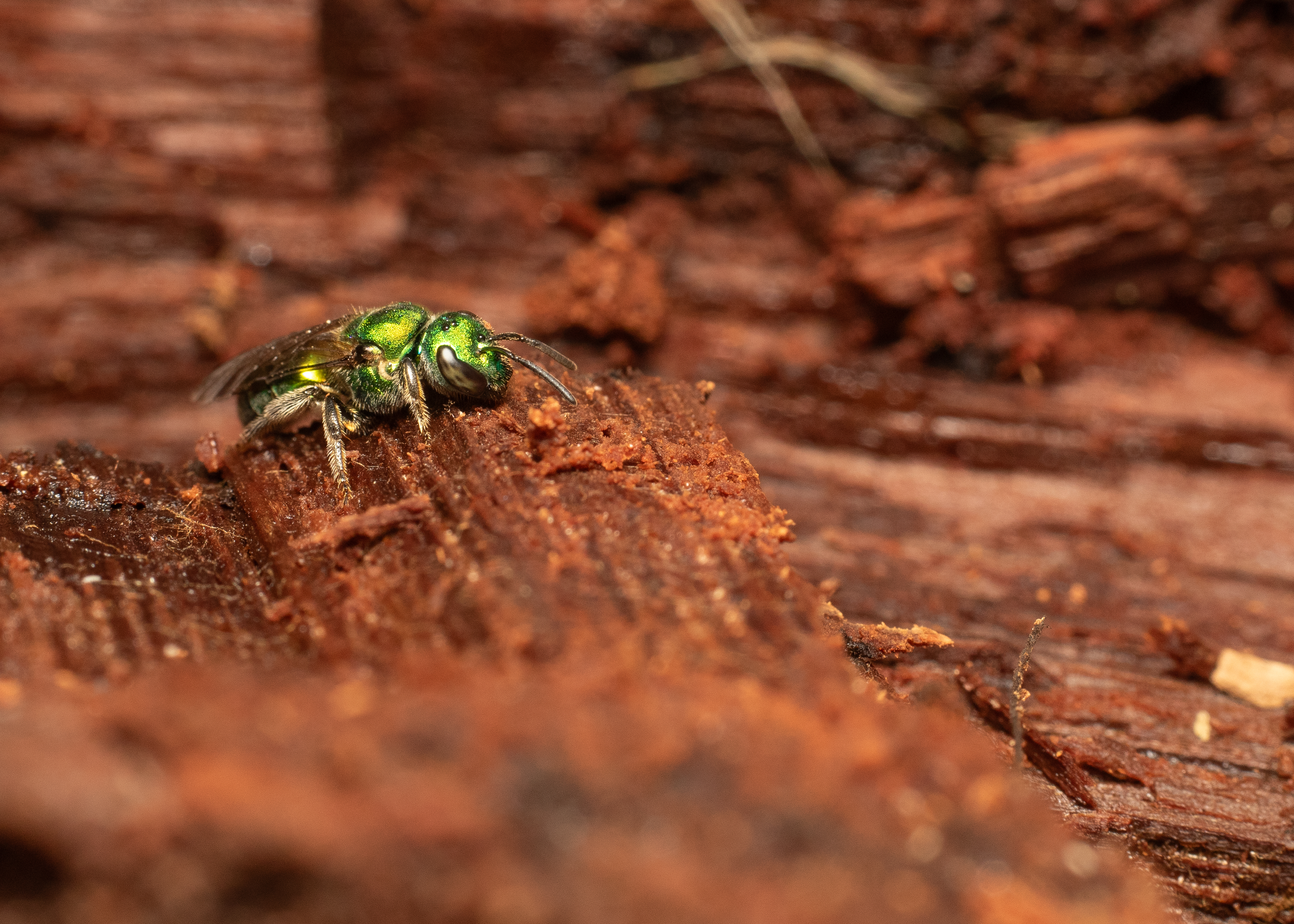

By early March, I am restless for bees to emerge. This weekend, I ventured out to Harms Woods in hopes of finding an overwintering site of pure gold sweat bees (Augochlora pura).
Herpetologists are fond of flipping logs to find snakes, salamanders, and frogs, gently replacing the logs as they were. I embraced the spirit of this method to find Augochlora. Last fall, mated females searched for a spot to spend the winter. There aren’t many descriptions of their overwintering habitat, other than “rotting logs” and possibly that females will overwinter near each other if suitable habitat is limiting1. I looked for moist rotting logs alongside the river, and gently split the wood open along the grid lines, careful not to destroy the structure of the log in the process.

Augochlora pura hibernate in rotting logs
On my fourth log of the day, I successfully found the overwintering quarters—the
“hibernacula”—of several Augochlora pura females! Although field identification of shiny green bees (collectively, the tribe Augochlorini) can be challenging, this species is the only one from that group to nest and overwinter in rotting logs (though other bees genus Lasioglossum do nest in rotting logs). My photographs further confirmed the identification: diagnostic forked mandibles, brown oval tegulae (not green and notched like Augochloropsis), and wide cheeks (unlike narrow cheeks of Augochlorella) that distinguish it from the other members of Augochlorini.

Three to four inches down into the log, I struck gold—err, emerald. Each metallic green sweat bee was located within her own tunnel, perfect cylinders that bored down into darkness. These females emerged last fall, mated with males, fattened up on nectar from asters and goldenrod, and tucked away in this log as temperatures dropped and daylight waned. The bees I found were alive and alert but sluggish. One poked her head up to investigate the bright light, another somersaulted around in the tunnel so that her tergites were showing, and a third waved her legs around. After taking a few photographs, I covered them up with bits of crushed wood, and looked for bees elsewhere in the log.
As I flaked off panels of wood, I saw the architecture of the nest: smooth sinuous tunnels plugged with what looked like brown wood dust. It’s not clear whether the material plugging the tunnels was produced by the bees, or was already present in the log and used by the bees to plug the tunnels. Reconstructing the nest from vertical cross sections is a thorny problem that I leave for another day. At the very least, it seems that females possibly reuse nesting tunnels from the nest as hibernacula.
Augochlora pura overwinter in groups
Sure enough, I encountered more bees as I descended into the log. Metallic green sweat bees were often clustered together in small groups of two to four. Bumble bee Bombus queens also overwinter together2, but in general, how adult bees choose where hibernate and the conditions that lead to aggregation is poorly known.
Augochlora may overwinter together, but this species is considered strictly solitary. Females build nests alone, and have been observed kicking out daughters once they emerge from their cells rather than coercing them to help raise brood as is the case with social or sub-social bees1.
In total, I found twelve Augochlora pura. The deepest bee I encountered was maybe eight inches deep, actually past the wood and into the soil beneath. If I hadn’t stopped searching to minimize my impact, it is quite possible that the log could have held at least twice this number.

Unlike some of the other logs that I checked which were dry and more brittle, the log they chose was consistently moist throughout. Moisture control for hibernating insects is key, and I suspect that some dry logs simply don’t make the cut. If I were to check other logs, I would have concentrated my efforts on those that seemed particularly moist.
Rotting logs are home to many insects
I also found other insects while searching for sweat bees. A click beetle with its legs clenched tight to its body, and another shiny green beetle (perhaps Poecilus lucublandus) that quickly dove back into the wood. One wonderful surprise was an overwintering bald-faced hornet queen (Dolichovespula maculata). She had carved out a small pecan-sized hibernacula beneath the log. She emerged last fall, mated, and then found a spot to hibernate while the rest of the hive died in the cold temperatures. For such a fierce predator during the growing season, the glimpse I had of her at rest told a more peaceful story.
Who knew a rotting log could hold so many secrets!

By the middle of April, the first Augochlora pura will emerge across eastern North America. They’ll complete two maybe three generations before fall depending on how long the growing season lasts. This solitary bee will occur in backyards and gardens, even in the middle of a city, provided that there’s a source of rotting wood nearby for nesting. They visit a wide array of flowers including dandelions (Taraxacum officicale), golden alexanders (Zizia), butterfly weed (Asclepias tuberosa), rose (Rosa blanda, R. carolina), ninebark (Physocarpus), shrubby dogwoods (Cornus), goldenrods (Solidago), and wood asters (Symphyotrichum).
1Stockhammer, K.A. 1966. Nesting Habits and Life Cycle of a Sweat Bee, Augochlora pura (Hymenoptera: Halictidae) J. Kans. Entomol. Soc. 39: 157-192.
2Pugesek, G., Thuma, J.A., and E.E. Crone. (2023) J. Insect Cons. First field-based estimates of bumblebee diapause survival rates showcase high survivorship in the wild. 27: 547-556.